
Learn · Module A
Rock Identification Lab
Look closely, ask the right questions and sort Oman’s rocks into their families — the way geologists do in the field.
The specimen collection
15 rocks, minerals and fossils from Oman’s story
2 are shown with real photographs — GeoAstro’s own or licensed specimens, credited in the Rock Explorer. The rest use a labelled Wissenschaftliche Illustration until a suitable photograph is approved.
- Magmatische GesteinePeridotitIllustration · photo needed
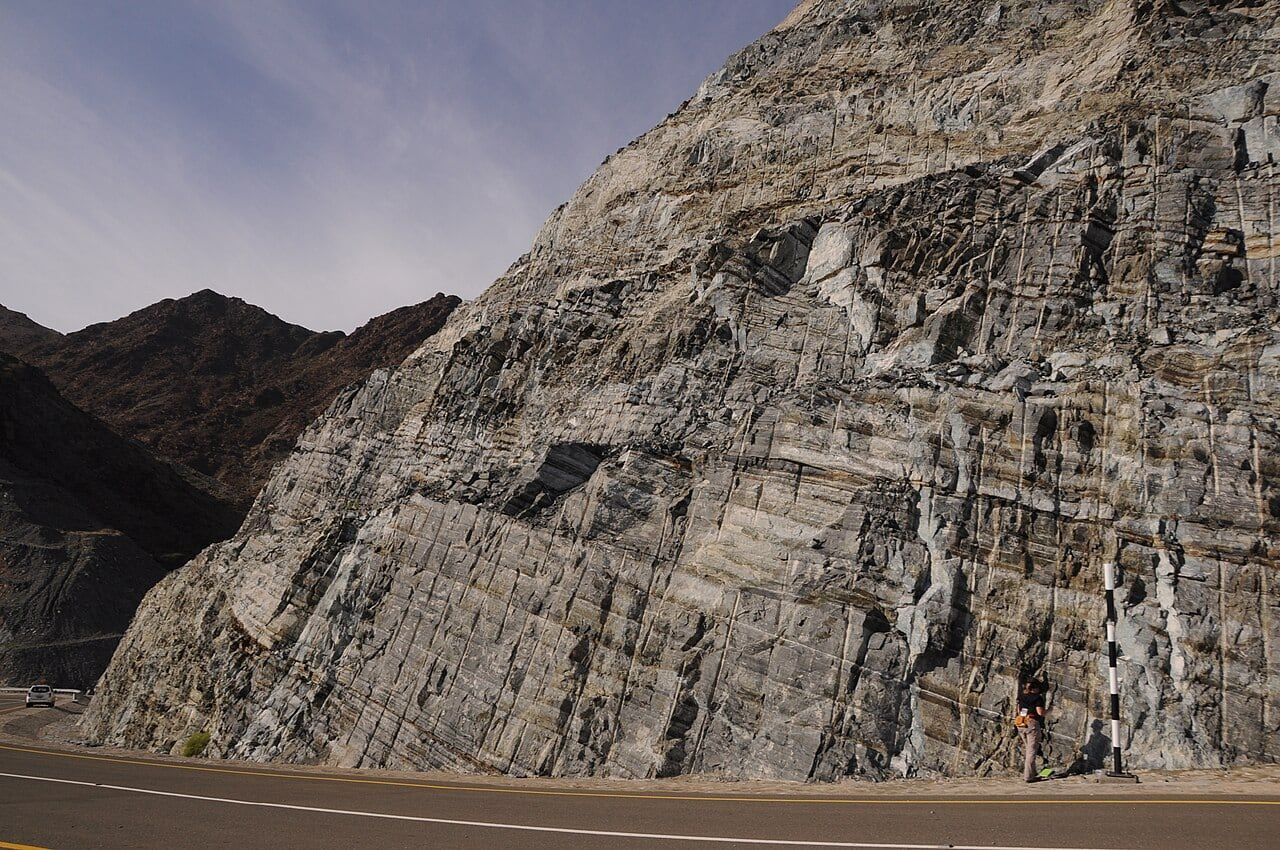
- Magmatische GesteineDolerit (Gangschwarm)Illustration · photo needed
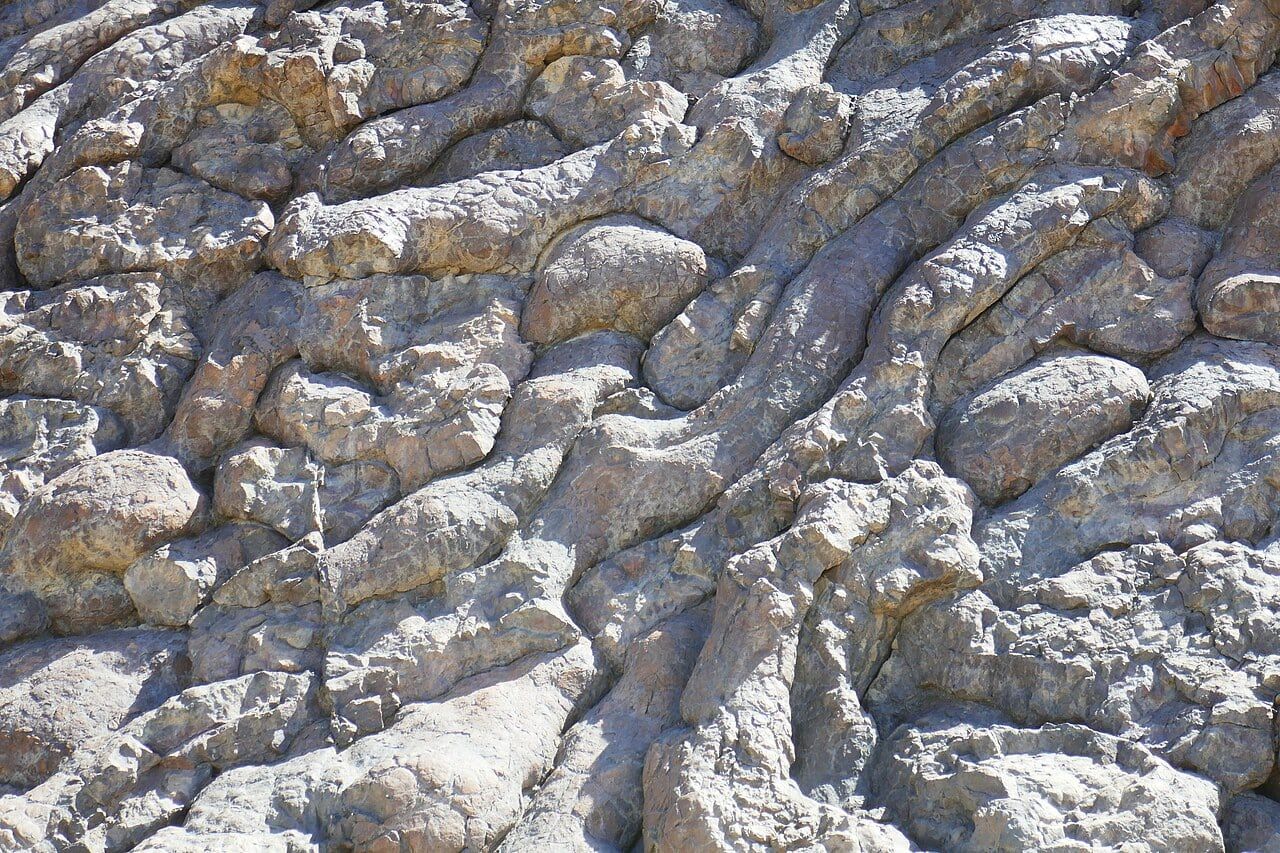
- SedimentgesteineKalksteinIllustration · photo needed
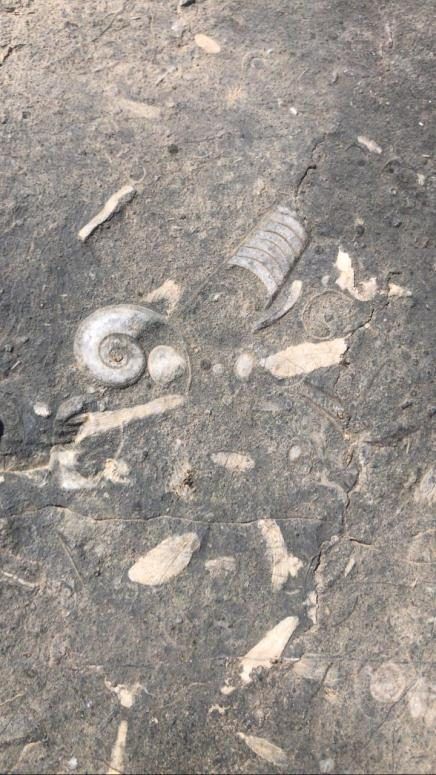
- FossilFossile KoralleIllustration · photo needed
- FossilStromatolithIllustration · photo needed
- SedimentgesteineGlaziale AblagerungIllustration · photo needed
- Metamorphe GesteineEklogitIllustration · photo needed
- Metamorphe GesteineMetamorphe Gesteine (Schiefer)Illustration · photo needed
- SedimentgesteineTravertinIllustration · photo needed
- StructureFutteralfalteIllustration · photo needed
- MineralOlivinIllustration · photo needed
- MineralGranatIllustration · photo needed
- MineralCalcitIllustration · photo needed
Identify a rock
Answer what you see — the key does the rest
Geologists identify rocks by looking closely: crystals or grains, layers, fossils and colour. Follow the questions as you would in the field.
Frage 1
What do you notice first about the rock?
Look at the whole rock first, then up close with a hand lens.
Frage 1
What kind of pattern can you see?
Frage 1
Is it porous or banded, like a spring deposit?
Geologists test these rocks with a drop of dilute acid: calcite fizzes. Only your guide does this test.
Frage 1
How are the crystals arranged?
Frage 1
How big are the crystals?
Crystal size tells you how fast the magma cooled.
Your rock is probably
Fossile Koralle
Fossil
- Looks like
- Honeycomb or branching patterns preserved in limestone.
- How it forms
- Remains of corals that lived on the shallow sea floor.
- In Oman
- Fossil corals occur in Oman’s limestones.
Your rock is probably
Stromatolith
Fossil
- Looks like
- Fine wavy or domed layers in carbonate rock.
- How it forms
- Built layer by layer by microbial mats that trapped sediment.
- In Oman
- Occur in Oman’s Neoproterozoic carbonate rocks.
Your rock is probably
Kalkstein
Sedimentgesteine
- Looks like
- Pale grey to cream rock, often containing fossils.
- How it forms
- Built up from calcium carbonate in warm, shallow seas.
- In Oman
- Thick Permian–Cretaceous limestones (Hajar Supergroup) form much of Jabal Akhdar; younger Tertiary limestones occur around Muscat.
Your rock is probably
Glaziale Ablagerung
Sedimentgesteine
- Looks like
- Pebbles and boulders of mixed sizes in a fine-grained matrix.
- How it forms
- Debris carried and dropped by glaciers.
- In Oman
- Neoproterozoic (Cryogenian) glacial deposits are preserved in Oman, including diamictites of the Abu Mahara Group on the Saiq Plateau of Jabal Akhdar.
Your rock is probably
Metamorphe Gesteine (Schiefer)
Metamorphe Gesteine
- Looks like
- Rocks with a layered, often shiny foliation.
- How it forms
- Existing rocks changed by heat and pressure without melting.
- In Oman
- The Saih Hatat area near Muscat contains metamorphic rocks formed during Late Cretaceous subduction.
Your rock is probably
Eklogit
Metamorphe Gesteine
- Looks like
- Green rock studded with red garnet crystals.
- How it forms
- Formed at very high pressure, deep in a subduction zone.
- In Oman
- High-pressure rocks of the Saih Hatat area, including As Sifah, formed in the Late Cretaceous (about 80 million years ago).
Your rock is probably
Gabbro
Magmatische Gesteine
- Looks like
- Coarse-grained, speckled dark and light crystals.
- How it forms
- Magma that cooled slowly deep in the oceanic crust.
- In Oman
- The lower crust of the Samail ophiolite; zircon in these gabbros is dated to about 96–95 million years ago.
Your rock is probably
Dolerit (Gangschwarm)
Magmatische Gesteine
- Looks like
- Medium-grained dark rock in parallel vertical sheets.
- How it forms
- Magma that filled cracks as the sea floor pulled apart, feeding the lavas above.
- In Oman
- The sheeted dyke complex of the Samail ophiolite.
Your rock is probably
Basalt und Kissenlava
Magmatische Gesteine
- Looks like
- Fine-grained dark rock forming rounded, pillow-shaped bodies.
- How it forms
- Basalt lava erupted under the sea and chilled quickly into pillows.
- In Oman
- Pillow lavas form the upper part of the ophiolite sequence; pillow lavas are also a stop on our Jabal Akhdar route.
Your rock is probably
Peridotit
Magmatische Gesteine
- Looks like
- Dense, dark green rock that often weathers to a rusty brown surface.
- How it forms
- Formed in Earth’s upper mantle, below the oceanic crust.
- In Oman
- Forms the mantle section of the Samail ophiolite in the Oman Mountains.
Your rock is probably
Travertin
Sedimentgesteine
- Looks like
- Pale, porous or banded carbonate rock.
- How it forms
- Carbonate minerals precipitated from spring water.
- In Oman
- Forms today where groundwater reacts with mantle peridotite; on the Saiq Plateau of Jabal Akhdar, older spring travertine was deposited where water emerged from limestone.
Still possible · 11
- Fossile Koralle
- Stromatolith
- Kalkstein
- Glaziale Ablagerung
- Metamorphe Gesteine (Schiefer)
- Eklogit
- Dolerit (Gangschwarm)
- Peridotit
- Travertin
A real identification needs a hand lens, a fresh surface and simple tests — ask your GeoAstro guide in the field.
Look closely
Use the lens like a field geologist
Move the magnifier over each specimen — with your mouse, your finger or the arrow keys — then answer what you observe.
Challenge 1 of 6
Move the lens over the rock. Can you see separate crystals?
Gabbro cooled slowly deep in the crust, so its crystals had time to grow large.
Challenge 2 of 6
What colour are the round crystals scattered through the green rock?
The red crystals are garnet, a mineral that grows at high pressure.
Challenge 3 of 6
How are the mineral grains arranged?
Heat and pressure line the minerals up, giving a layered texture called foliation.
Challenge 4 of 6
Are the pebbles all the same size?
Glaciers carry and drop debris of every size together, so glacial deposits are poorly sorted.
Challenge 5 of 6
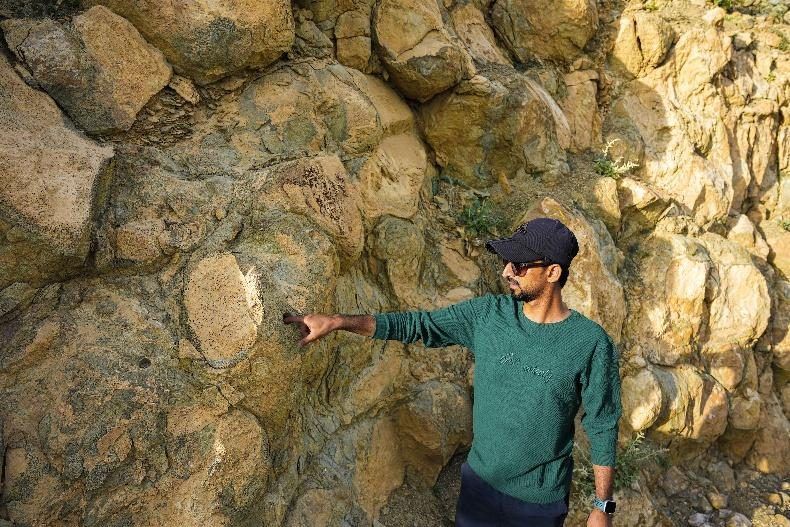
Look at the rock face the guide is pointing to. Which shapes tell you how this lava erupted?
Rounded pillows form when lava erupts under water and its surface chills instantly.
Challenge 6 of 6
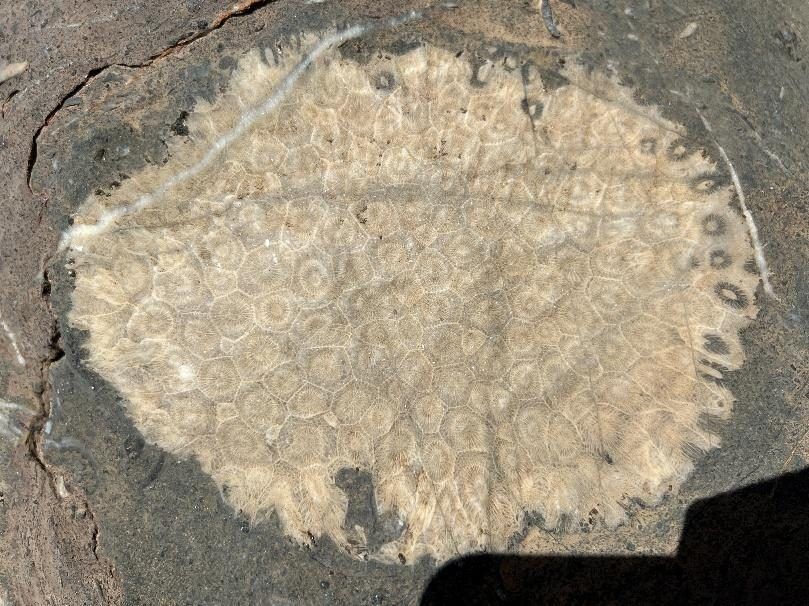
Look closely at the cut surface. What does the pattern come from?
Honeycomb or branching patterns preserved in limestone are the remains of corals.
Classification activity
Sort the rocks into their families
Tap a specimen, then tap the family you think it belongs to. Think about how each rock formed.
Wählen Sie zum Start eine Probe.
Educational comparisons
Similar at first sight, different stories
Comparing rocks side by side is how geologists learn what each clue means.
Gabbro
Dolerit (Gangschwarm)
Basalt und Kissenlava
Gabbro, dolerite and basalt can form from similar magma. What changes is how fast it cooled: slowly deep in the crust gives large crystals; quickly on the sea floor gives tiny ones.
Kalkstein
Travertin
Both are made mostly of calcite. Limestone built up in warm, shallow seas; travertine precipitates from spring water.
Metamorphe Gesteine (Schiefer)
Eklogit
Both are metamorphic rocks. Schist shows minerals lined up in layers; eclogite formed at very high pressure, deep in a subduction zone, and contains red garnet.
Fossile Koralle
Stromatolith
Fossil corals are the remains of animals that lived on the shallow sea floor. Stromatolites were built layer by layer by microbial mats — among the oldest traces of life.
Compare any two specimens
Magmatische Gesteine
Peridotit
- Looks like
- Dense, dark green rock that often weathers to a rusty brown surface.
- How it forms
- Formed in Earth’s upper mantle, below the oceanic crust.
- Minerals
- Olivine, Pyroxene, Serpentine (alteration)
Magmatische Gesteine
Gabbro
- Looks like
- Coarse-grained, speckled dark and light crystals.
- How it forms
- Magma that cooled slowly deep in the oceanic crust.
- Minerals
- Plagioclase, Pyroxene
Magmatische Gesteine
Dolerit (Gangschwarm)
- Looks like
- Medium-grained dark rock in parallel vertical sheets.
- How it forms
- Magma that filled cracks as the sea floor pulled apart, feeding the lavas above.
Magmatische Gesteine
Basalt und Kissenlava
- Looks like
- Fine-grained dark rock forming rounded, pillow-shaped bodies.
- How it forms
- Basalt lava erupted under the sea and chilled quickly into pillows.
Sedimentgesteine
Kalkstein
- Looks like
- Pale grey to cream rock, often containing fossils.
- How it forms
- Built up from calcium carbonate in warm, shallow seas.
- Minerals
- Calcit
Fossil
Fossile Koralle
- Looks like
- Honeycomb or branching patterns preserved in limestone.
- How it forms
- Remains of corals that lived on the shallow sea floor.
Fossil
Stromatolith
- Looks like
- Fine wavy or domed layers in carbonate rock.
- How it forms
- Built layer by layer by microbial mats that trapped sediment.
Sedimentgesteine
Glaziale Ablagerung
- Looks like
- Pebbles and boulders of mixed sizes in a fine-grained matrix.
- How it forms
- Debris carried and dropped by glaciers.
Metamorphe Gesteine
Eklogit
- Looks like
- Green rock studded with red garnet crystals.
- How it forms
- Formed at very high pressure, deep in a subduction zone.
- Minerals
- Garnet, Omphacite
Metamorphe Gesteine
Metamorphe Gesteine (Schiefer)
- Looks like
- Rocks with a layered, often shiny foliation.
- How it forms
- Existing rocks changed by heat and pressure without melting.
Sedimentgesteine
Travertin
- Looks like
- Pale, porous or banded carbonate rock.
- How it forms
- Carbonate minerals precipitated from spring water.
Structure
Futteralfalte
- Looks like
- A tube- or cone-shaped fold in strongly deformed rock.
- How it forms
- Formed when rock is intensely sheared and stretched.
Mineral
Olivin
- Looks like
- Olive-green glassy grains.
- How it forms
- A main mineral of Earth’s upper mantle.
Mineral
Granat
- Looks like
- Deep red, rounded crystals.
- How it forms
- Grows in rocks under high pressure and temperature.
Mineral
Calcit
- Looks like
- White to colourless mineral, the main component of limestone and travertine.
- How it forms
- Precipitates from sea water, spring water or living organisms.
Magmatische Gesteine
Peridotit
- Looks like
- Dense, dark green rock that often weathers to a rusty brown surface.
- How it forms
- Formed in Earth’s upper mantle, below the oceanic crust.
- Minerals
- Olivine, Pyroxene, Serpentine (alteration)
Magmatische Gesteine
Gabbro
- Looks like
- Coarse-grained, speckled dark and light crystals.
- How it forms
- Magma that cooled slowly deep in the oceanic crust.
- Minerals
- Plagioclase, Pyroxene
Magmatische Gesteine
Dolerit (Gangschwarm)
- Looks like
- Medium-grained dark rock in parallel vertical sheets.
- How it forms
- Magma that filled cracks as the sea floor pulled apart, feeding the lavas above.
Magmatische Gesteine
Basalt und Kissenlava
- Looks like
- Fine-grained dark rock forming rounded, pillow-shaped bodies.
- How it forms
- Basalt lava erupted under the sea and chilled quickly into pillows.
Sedimentgesteine
Kalkstein
- Looks like
- Pale grey to cream rock, often containing fossils.
- How it forms
- Built up from calcium carbonate in warm, shallow seas.
- Minerals
- Calcit
Fossil
Fossile Koralle
- Looks like
- Honeycomb or branching patterns preserved in limestone.
- How it forms
- Remains of corals that lived on the shallow sea floor.
Fossil
Stromatolith
- Looks like
- Fine wavy or domed layers in carbonate rock.
- How it forms
- Built layer by layer by microbial mats that trapped sediment.
Sedimentgesteine
Glaziale Ablagerung
- Looks like
- Pebbles and boulders of mixed sizes in a fine-grained matrix.
- How it forms
- Debris carried and dropped by glaciers.
Metamorphe Gesteine
Eklogit
- Looks like
- Green rock studded with red garnet crystals.
- How it forms
- Formed at very high pressure, deep in a subduction zone.
- Minerals
- Garnet, Omphacite
Metamorphe Gesteine
Metamorphe Gesteine (Schiefer)
- Looks like
- Rocks with a layered, often shiny foliation.
- How it forms
- Existing rocks changed by heat and pressure without melting.
Sedimentgesteine
Travertin
- Looks like
- Pale, porous or banded carbonate rock.
- How it forms
- Carbonate minerals precipitated from spring water.
Structure
Futteralfalte
- Looks like
- A tube- or cone-shaped fold in strongly deformed rock.
- How it forms
- Formed when rock is intensely sheared and stretched.
Mineral
Olivin
- Looks like
- Olive-green glassy grains.
- How it forms
- A main mineral of Earth’s upper mantle.
Mineral
Granat
- Looks like
- Deep red, rounded crystals.
- How it forms
- Grows in rocks under high pressure and temperature.
Mineral
Calcit
- Looks like
- White to colourless mineral, the main component of limestone and travertine.
- How it forms
- Precipitates from sea water, spring water or living organisms.
Lernen im Gelände
Unterricht unter freiem Himmel mit GeoAstro Oman
Geologie-Programm für Schulen
Vorbereitung im Unterricht, eine geführte Exkursion und Nachbereitung für Ihre Klasse.
Geologie-Schulprogramm buchenBuchungsanfrage per WhatsApp (öffnet WhatsApp in einem neuen Tab)Geologie-Tour Maskat
Sieben Stopps vom Ophiolith bis zum Eklogit von Sifah.
Geologie-Tour Maskat buchenBuchungsanfrage per WhatsApp (öffnet WhatsApp in einem neuen Tab)Geologie-Tour Jabal Akhdar
Fünf Stopps vom Coral Park bis zur Kulturwanderung im Dorf Al Ain.
Geologie-Tour Jabal Akhdar buchenBuchungsanfrage per WhatsApp (öffnet WhatsApp in einem neuen Tab)Geländeprogramm für Hochschulen
Geländebeschreibung, Strukturen und Fachliteratur – in Omans Bergen.
Geländeprogramm für Hochschulen anfragenBuchungsanfrage per WhatsApp (öffnet WhatsApp in einem neuen Tab)
Eine WhatsApp-Nachricht ist eine Anfrage, keine bestätigte Buchung. Unser Team antwortet Ihnen, um Verfügbarkeit, Details und Programm zu bestätigen. Die Erlebnisse hängen von Himmel und Wetter ab.