Startseite Geo Lab Gesteine, Minerale und Fossilien
Read Oman’s rocks like a geologist Filter by type, search, and open any specimen to learn how it formed, where it occurs in Oman and where to see it on our tours.
Die ausführlichen wissenschaftlichen Erläuterungen des Geo Lab sind noch auf Englisch. Sie werden übersetzt, sobald unsere Geologin bzw. unser Geologe sie freigegeben hat.
No specimens match your search.
Scientific illustration · photo needed Magmatische Gesteine Peridotit Dense, dark green rock that often weathers to a rusty brown surface. Draft Foto · Oman Magmatische Gesteine Gabbro Coarse-grained, speckled dark and light crystals. Draft Scientific illustration · photo needed Magmatische Gesteine Dolerit (Gangschwarm) Medium-grained dark rock in parallel vertical sheets. Draft Foto · Oman Magmatische Gesteine Basalt und Kissenlava Fine-grained dark rock forming rounded, pillow-shaped bodies. Draft Scientific illustration · photo needed Sedimentgesteine Kalkstein Pale grey to cream rock, often containing fossils. Draft Scientific illustration · photo needed Fossil Fossile Koralle Honeycomb or branching patterns preserved in limestone. Draft Scientific illustration · photo needed Fossil Stromatolith Fine wavy or domed layers in carbonate rock. Draft Scientific illustration · photo needed Sedimentgesteine Glaziale Ablagerung Pebbles and boulders of mixed sizes in a fine-grained matrix. Draft Scientific illustration · photo needed Metamorphe Gesteine Eklogit Green rock studded with red garnet crystals. Draft Scientific illustration · photo needed Metamorphe Gesteine Metamorphe Gesteine (Schiefer) Rocks with a layered, often shiny foliation. Draft Scientific illustration · photo needed Sedimentgesteine Travertin Pale, porous or banded carbonate rock. Draft
Squeezed Squeezed Hinge: where the beds bend most sharply Anticline: beds fold upward into an arch Limb: the sloping side Syncline: beds fold down into a trough Thin alternating beds make the folds easy to see LEGEND · NOT TO SCALE Light bed Darker bed FOLDED STRATA · CONCEPT SKETCH Scientific illustration · photo needed Structure Futteralfalte A tube- or cone-shaped fold in strongly deformed rock. Draft Scientific illustration · photo needed Mineral Olivin Olive-green glassy grains. Draft Scientific illustration · photo needed Mineral Granat Deep red, rounded crystals. Draft Scientific illustration · photo needed Mineral Calcit White to colourless mineral, the main component of limestone and travertine. Draft × Magmatische Gesteine
Peridotit Dense, dark green rock Rusty-brown weathered patches Peridotit about 5 cm (illustrative) HAND SPECIMEN · SCIENTIFIC ILLUSTRATION Wissenschaftliche Illustration of a typical peridotite hand specimen, with the features that identify it — not a photograph. An approved specimen photograph is still needed.
How to recognise it Dense, dark green rock that often weathers to a rusty brown surface.
How it formed Formed in Earth’s upper mantle, below the oceanic crust.
In Oman Forms the mantle section of the Samail ophiolite in the Oman Mountains.
Why it matters A rare chance to walk on rock from the mantle. Its reaction with water and CO₂ is studied for natural carbon capture.
Key minerals Olivine · Pyroxene · Serpentine (alteration) Magmatische Gesteine
Gabbro Foto · Oman ⤢ Layered gabbro — Al Batinah Region, Oman Anita Di Chiara · CC BY 3.0 Identifications and locations are as stated by each source and are pending confirmation by our geologist.
How to recognise it Coarse-grained, speckled dark and light crystals.
How it formed Magma that cooled slowly deep in the oceanic crust.
In Oman The lower crust of the Samail ophiolite; zircon in these gabbros is dated to about 96–95 million years ago.
Why it matters Its precise ages tell us when this piece of ocean floor was born.
Key minerals Plagioclase · Pyroxene Magmatische Gesteine
Dolerit (Gangschwarm) Medium-sized grey crystals Parallel sheet margins Dolerit (Gangschwarm) about 5 cm (illustrative) HAND SPECIMEN · SCIENTIFIC ILLUSTRATION Wissenschaftliche Illustration of a typical dolerite (sheeted dykes) hand specimen, with the features that identify it — not a photograph. An approved specimen photograph is still needed.
How to recognise it Medium-grained dark rock in parallel vertical sheets.
How it formed Magma that filled cracks as the sea floor pulled apart, feeding the lavas above.
In Oman The sheeted dyke complex of the Samail ophiolite.
Why it matters Shows how oceanic crust grows at spreading ridges. Magmatische Gesteine
Basalt und Kissenlava Foto · Oman ⤢ Pillow lava, Semail ophiolite — Wadi Jizzi, Oman Lionel Duchoiselle · CC BY-SA 3.0 Identifications and locations are as stated by each source and are pending confirmation by our geologist.
How to recognise it Fine-grained dark rock forming rounded, pillow-shaped bodies.
How it formed Basalt lava erupted under the sea and chilled quickly into pillows.
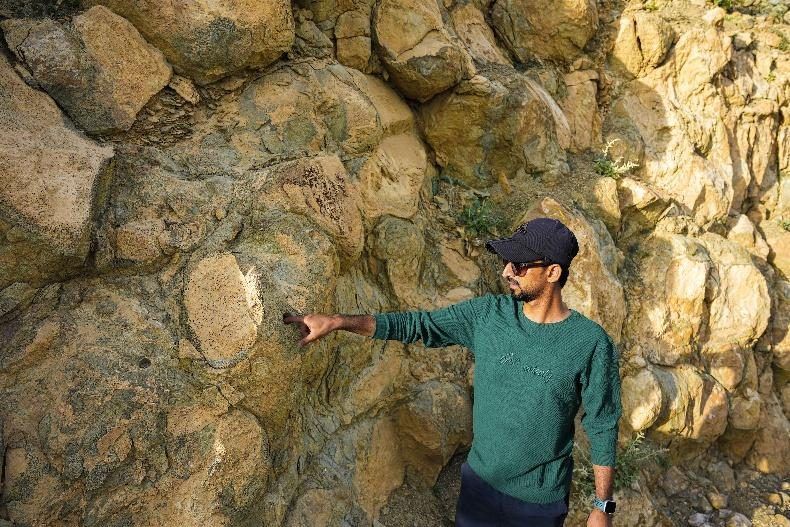
In Oman Pillow lavas form the upper part of the ophiolite sequence; pillow lavas are also a stop on our Jabal Akhdar route.
Why it matters Pillow shapes prove an eruption happened under water. Sedimentgesteine
Kalkstein Pale, fine-grained rock Shell fragments Kalkstein about 5 cm (illustrative) HAND SPECIMEN · SCIENTIFIC ILLUSTRATION Wissenschaftliche Illustration of a typical limestone hand specimen, with the features that identify it — not a photograph. An approved specimen photograph is still needed.
How to recognise it Pale grey to cream rock, often containing fossils.
How it formed Built up from calcium carbonate in warm, shallow seas.
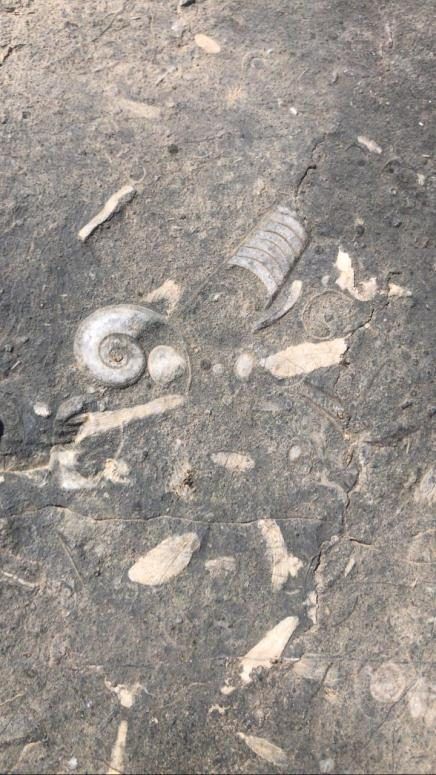
In Oman Thick Permian–Cretaceous limestones (Hajar Supergroup) form much of Jabal Akhdar; younger Tertiary limestones occur around Muscat.
Why it matters Each layer records the seas that once covered Oman.
Key minerals Calcit
See it with GeoAstro Tertiary limestone — Muscat route Fossil
Fossile Koralle Honeycomb pattern of coral cells Fossile Koralle about 5 cm (illustrative) HAND SPECIMEN · SCIENTIFIC ILLUSTRATION Wissenschaftliche Illustration of a typical fossil coral hand specimen, with the features that identify it — not a photograph. An approved specimen photograph is still needed.
How to recognise it Honeycomb or branching patterns preserved in limestone.
How it formed Remains of corals that lived on the shallow sea floor.
In Oman Fossil corals occur in Oman’s limestones.
Why it matters Corals show that the area was once a warm, shallow sea. Fossil
Stromatolith Fine wavy layers Domed growth Stromatolith about 5 cm (illustrative) HAND SPECIMEN · SCIENTIFIC ILLUSTRATION Wissenschaftliche Illustration of a typical stromatolite hand specimen, with the features that identify it — not a photograph. An approved specimen photograph is still needed.
How to recognise it Fine wavy or domed layers in carbonate rock.
How it formed Built layer by layer by microbial mats that trapped sediment.
In Oman Occur in Oman’s Neoproterozoic carbonate rocks.
Why it matters Among the oldest traces of life on Earth.
See it with GeoAstro Geology and cultural hike — Jabal Akhdar route Sedimentgesteine
Glaziale Ablagerung Pebbles and boulders of many sizes Fine-grained matrix Glaziale Ablagerung about 5 cm (illustrative) HAND SPECIMEN · SCIENTIFIC ILLUSTRATION Wissenschaftliche Illustration of a typical glacial deposit hand specimen, with the features that identify it — not a photograph. An approved specimen photograph is still needed.
How to recognise it Pebbles and boulders of mixed sizes in a fine-grained matrix.
How it formed Debris carried and dropped by glaciers.
In Oman Neoproterozoic (Cryogenian) glacial deposits are preserved in Oman, including diamictites of the Abu Mahara Group on the Saiq Plateau of Jabal Akhdar.
Why it matters Evidence for the “Snowball Earth” ice ages.
See it with GeoAstro Geology and cultural hike — Jabal Akhdar route Metamorphe Gesteine
Eklogit Round red garnet crystals Green pyroxene (omphacite) Eklogit about 5 cm (illustrative) HAND SPECIMEN · SCIENTIFIC ILLUSTRATION Wissenschaftliche Illustration of a typical eclogite hand specimen, with the features that identify it — not a photograph. An approved specimen photograph is still needed.
How to recognise it Green rock studded with red garnet crystals.
How it formed Formed at very high pressure, deep in a subduction zone.
In Oman High-pressure rocks of the Saih Hatat area, including As Sifah, formed in the Late Cretaceous (about 80 million years ago).
Why it matters Shows that rocks from the edge of Arabia went deep into the Earth and came back.
Key minerals Garnet · Omphacite
See it with GeoAstro Sifah eclogite — Muscat route Metamorphe Gesteine
Metamorphe Gesteine (Schiefer) Shiny minerals in aligned layers (foliation) Metamorphe Gesteine (Schiefer) about 5 cm (illustrative) HAND SPECIMEN · SCIENTIFIC ILLUSTRATION Wissenschaftliche Illustration of a typical metamorphic rocks (schist) hand specimen, with the features that identify it — not a photograph. An approved specimen photograph is still needed.
How to recognise it Rocks with a layered, often shiny foliation.
How it formed Existing rocks changed by heat and pressure without melting.
In Oman The Saih Hatat area near Muscat contains metamorphic rocks formed during Late Cretaceous subduction.
Why it matters They record the pressures and temperatures rocks experienced. Sedimentgesteine
Travertin Banded layers Small pores Travertin about 5 cm (illustrative) HAND SPECIMEN · SCIENTIFIC ILLUSTRATION Wissenschaftliche Illustration of a typical travertine hand specimen, with the features that identify it — not a photograph. An approved specimen photograph is still needed.
How to recognise it Pale, porous or banded carbonate rock.
How it formed Carbonate minerals precipitated from spring water.
In Oman Forms today where groundwater reacts with mantle peridotite; on the Saiq Plateau of Jabal Akhdar, older spring travertine was deposited where water emerged from limestone.
Why it matters A natural example of rocks capturing carbon dioxide.
See it with GeoAstro Geology and cultural hike — Jabal Akhdar route Structure
Futteralfalte
Squeezed Squeezed Hinge: where the beds bend most sharply Anticline: beds fold upward into an arch Limb: the sloping side Syncline: beds fold down into a trough Thin alternating beds make the folds easy to see LEGEND · NOT TO SCALE Light bed Darker bed FOLDED STRATA · CONCEPT SKETCH Wissenschaftliche Illustration — Concept sketch of thin beds squeezed into folds. A sheath fold is a more intensely sheared, tube-shaped fold (see the slider). Not a photograph. An approved photograph is still needed.
How to recognise it A tube- or cone-shaped fold in strongly deformed rock.
How it formed Formed when rock is intensely sheared and stretched.
In Oman Sheath folds occur in the deformed rocks of the Saih Hatat region near Muscat, including spectacular folds in Permian Saiq Formation limestones at Wadi Al Mayh.
Why it matters Records the extreme deformation as rocks returned from depth.
See it with GeoAstro Wadi Al Mayh — Muscat route Mineral
Olivin Olive-green glassy grains Olivin about 5 cm (illustrative) HAND SPECIMEN · SCIENTIFIC ILLUSTRATION Wissenschaftliche Illustration of a typical olivine hand specimen, with the features that identify it — not a photograph. An approved specimen photograph is still needed.
How to recognise it Olive-green glassy grains.
How it formed A main mineral of Earth’s upper mantle.
In Oman The main mineral of the ophiolite’s mantle peridotite.
Why it matters Reacts with water and CO₂, forming carbonate minerals. Mineral
Granat Deep red rounded crystals Granat about 5 cm (illustrative) HAND SPECIMEN · SCIENTIFIC ILLUSTRATION Wissenschaftliche Illustration of a typical garnet hand specimen, with the features that identify it — not a photograph. An approved specimen photograph is still needed.
How to recognise it Deep red, rounded crystals.
How it formed Grows in rocks under high pressure and temperature.
In Oman A key mineral of the As Sifah eclogites.
Why it matters Its chemistry helps geologists work out how deep rocks were buried. Veröffentlichte Deutung Entwurf · geologische Prüfung ausstehend Quellen: Searle et al. 1994 Mineral
Calcit Rhomb-shaped crystals White to colourless Calcit about 5 cm (illustrative) HAND SPECIMEN · SCIENTIFIC ILLUSTRATION Wissenschaftliche Illustration of a typical calcite hand specimen, with the features that identify it — not a photograph. An approved specimen photograph is still needed.
How to recognise it White to colourless mineral, the main component of limestone and travertine.
How it formed Precipitates from sea water, spring water or living organisms.
In Oman Makes up Oman’s limestones and the travertine forming today.
Why it matters Records ancient seas and modern carbon capture. Erleben Sie es live
Erwandern Sie mit uns Omans geologische Geschichte Eine WhatsApp-Nachricht ist eine Anfrage, keine bestätigte Buchung. Unser Team antwortet Ihnen, um Verfügbarkeit, Details und Programm zu bestätigen. Die Erlebnisse hängen von Himmel und Wetter ab.