Les explications scientifiques détaillées du Geo Lab sont encore en anglais. Elles seront traduites une fois validées par notre géologue.
Oman’s geological history
Watch Oman’s rocks come together
Step through 9 chapters, from ice ages to rocks still forming today. Each scene is a simplified cross-section — not to scale.
oldertoday
Scientific illustration · simplified model
1 / 9
Chapter 1 · Cryogenian · about 720–635 Ma
Ice ages leave their mark
Glaciers left glacial deposits that are preserved in Oman, including in the Jabal Akhdar area, where two glacial episodes are recorded around 740–700 and 650–630 million years ago. They are part of the evidence for the global “Snowball Earth” ice ages.
For a long span from the Permian to the Cretaceous, the edge of Arabia lay under shallow seas where thick limestones accumulated. Known as the Hajar Supergroup, these fossil-bearing limestones now form much of Jabal Akhdar.
Magma rising at an oceanic spreading centre created the crust and mantle section now called the Samail (Semail) ophiolite. Zircon crystals in its gabbros have been dated to about 96–95 million years ago.
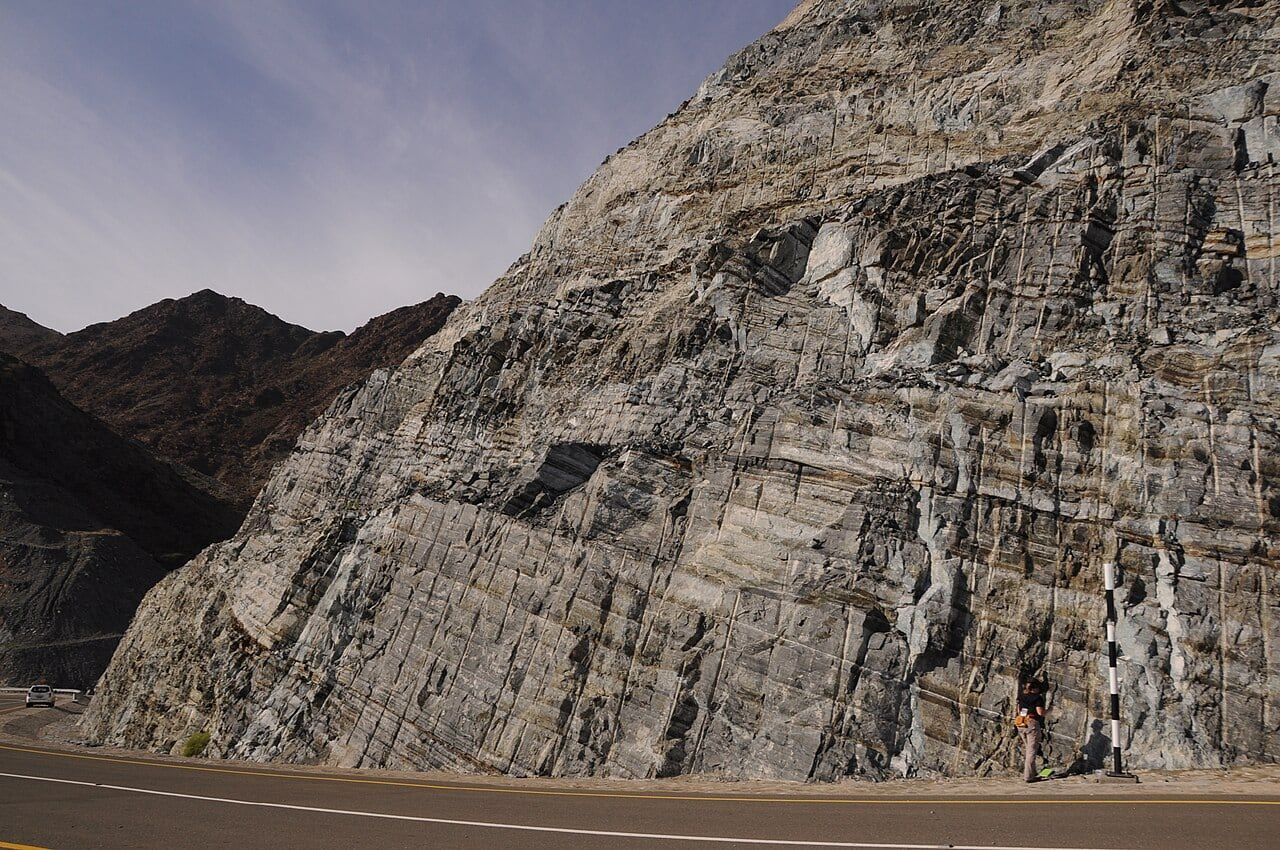
Soon after it formed, the slab of ocean floor was thrust (obducted) onto the edge of the Arabian continent. Rocks at its base — the metamorphic sole — formed at about the same time as its crust.
Part of the Arabian continental margin was carried to great depth and transformed into high-pressure rocks, such as the eclogites near As Sifah, before returning to the surface — strongly folded on the way.
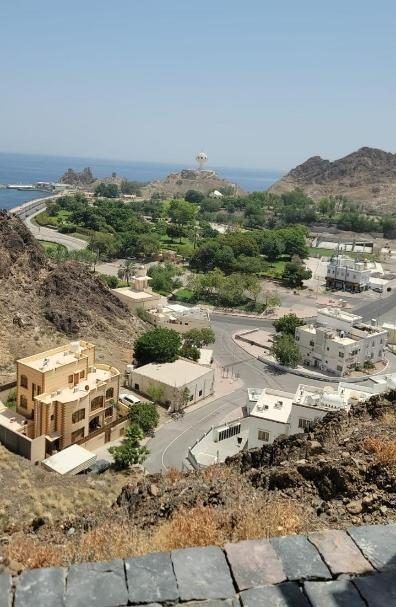
After the ophiolite was emplaced, shallow seas again covered parts of northern Oman and deposited younger, fossil-rich limestones, seen today around Muscat.
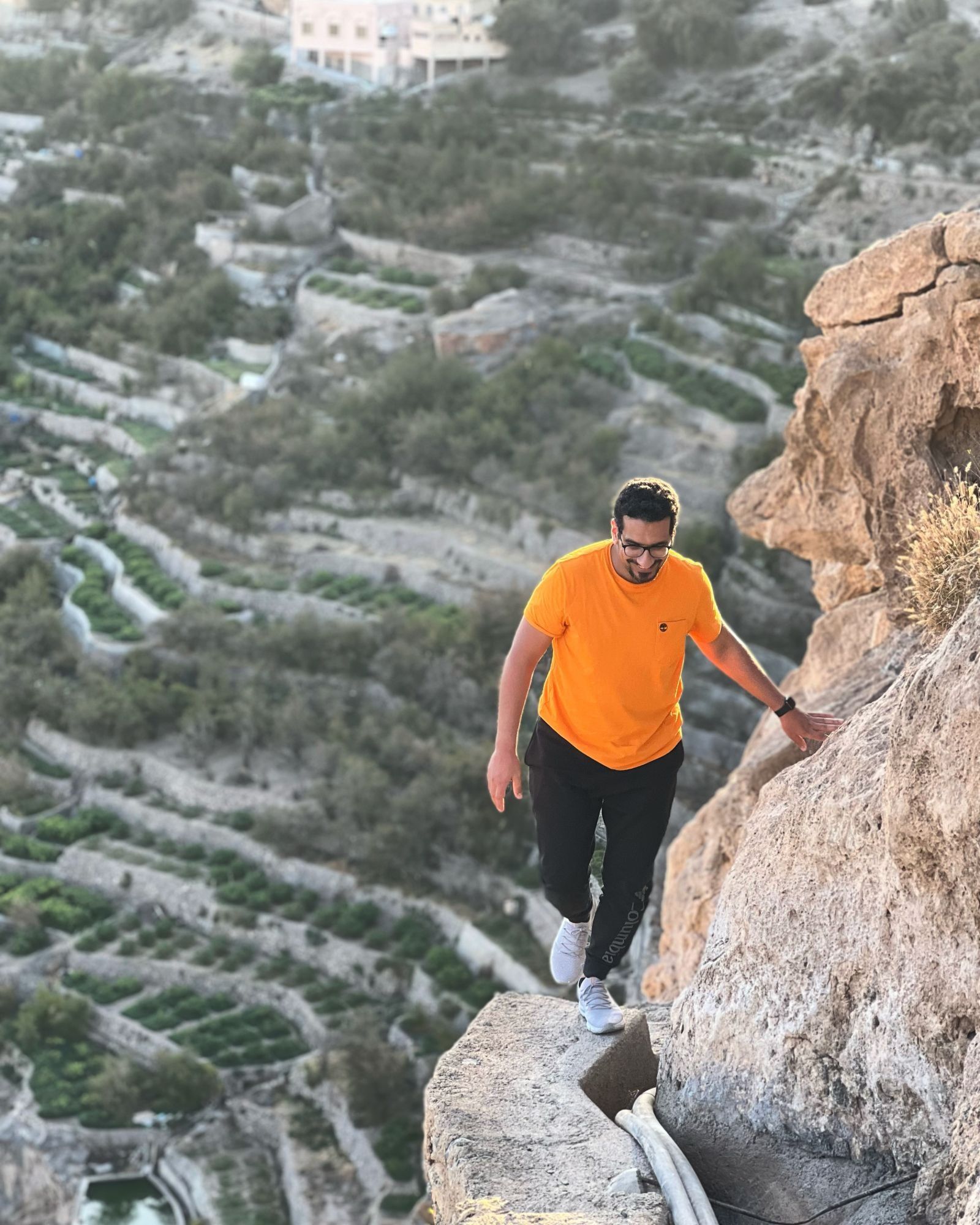
Later uplift and folding shaped the Oman Mountains, including the great dome of Jabal Akhdar, while erosion carved deep wadis and canyons. Field guides of the Geological Society of Oman relate this mountain building to the collision of Arabia with Eurasia from about the Oligocene–Miocene onwards; the exact timing is still studied by geologists.
Where groundwater reacts with mantle peridotite, new carbonate minerals and travertine are still forming — a natural process studied for capturing carbon dioxide.
MesuréBrouillon · en attente de validation par un géologueSources : Kelemen & Matter 2008
Modèle simplifiéBrouillon · en attente de validation par un géologueSources : Grotzinger & Jordan 2014
Modèle simplifié Cooling speed and crystal size
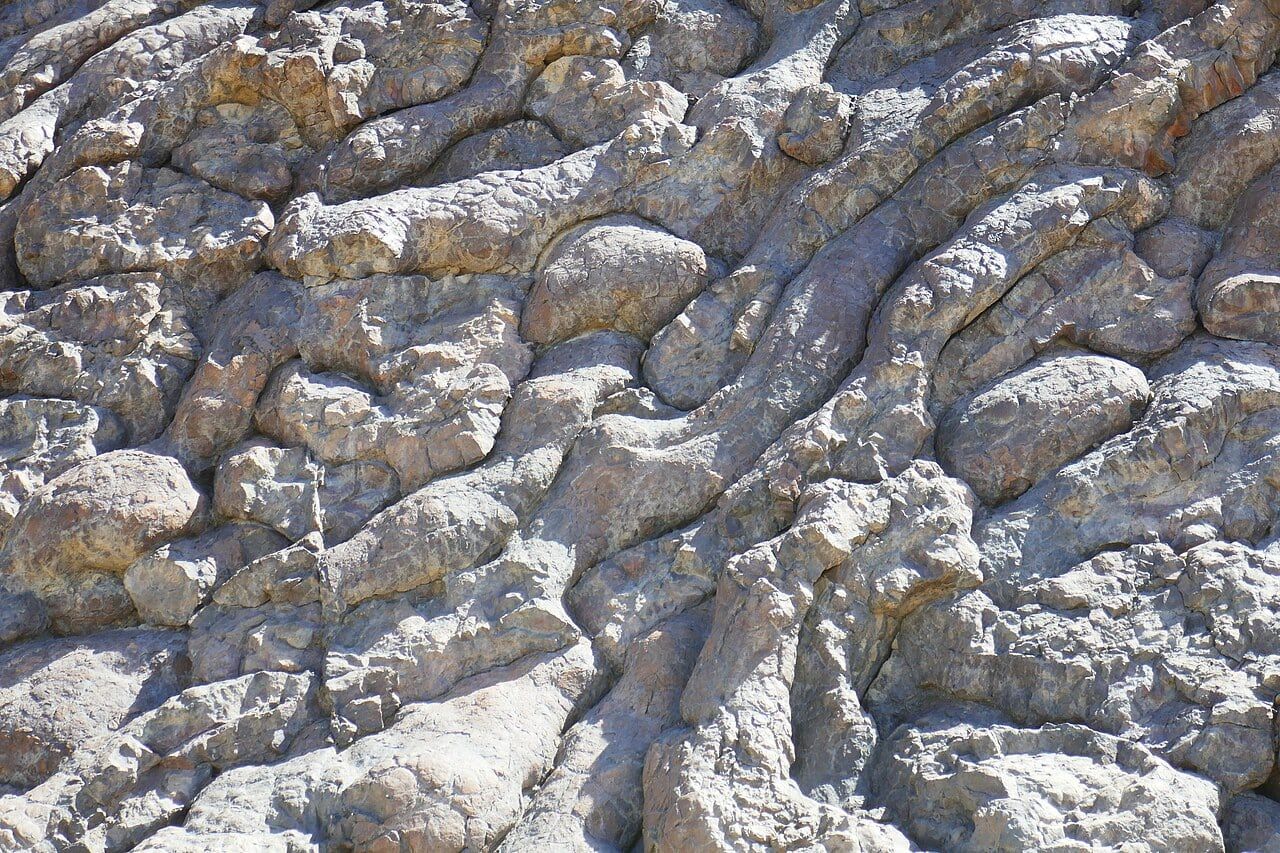
Very slow cooling, deep in the crust: large crystals. Like gabbroSlow cooling: crystals are still easy to see.Moderate cooling in narrow cracks: medium crystals. Like dolerite (sheeted dykes)Fast cooling: crystals become hard to see.Very fast cooling where lava meets sea water: tiny crystals. Like basalt & pillow lava
Watch mineral grains line up as a rock is metamorphosed.
Minerals in random orientations.Heat and pressure begin to act.Grains rotate and recrystallise.Aligned grains give a layered “foliation” — without melting.
Modèle simplifiéBrouillon · en attente de validation par un géologueSources : Grotzinger & Jordan 2014
Modèle simplifié Deep burial
Follow a rock carried down a subduction zone until garnet grows.
Rock at the edge of the continent.Carried down beneath the overriding plate.Pressure keeps rising with depth.At very high pressure new minerals such as red garnet grow: eclogite.
Shear flat layers until they form a tube-shaped sheath fold.
Flat, layered rock.Shearing starts to buckle the layers.The fold tightens.Intense shear stretches the fold.A tube- or cone-shaped sheath fold.
Modèle simplifiéBrouillon · en attente de validation par un géologueSources : Grotzinger & Jordan 2014
Concept sketches: how Oman’s landscapes were shaped
Illustration scientifiqueFolded strata. Concept sketch of thin beds squeezed into folds. A sheath fold is a more intensely sheared, tube-shaped fold (see the slider).
Illustration scientifiqueFaults. Concept sketch of normal and reverse faults and thrusts.
Illustration scientifiqueMetamorphism. Concept sketch: heat and pressure change a rock without melting it, lining its minerals up.
Illustration scientifiqueWadi and canyon. Concept sketch of a wadi cut into layered rock by flash floods.
Illustration scientifiqueSand dune. Concept sketch of how wind builds a dune: a gentle windward slope and a steep slip face.
Modèle géologique simplifiéSaiq Plateau rock column. Simplified column: glacial and carbonate Precambrian rocks, the angular unconformity, then Permian and Triassic limestones and young travertine.
Connect to the field
Walk through these chapters for real
Geology of Muscat
Seven stops from Oman’s stratigraphy to the Sifah eclogite
Un message WhatsApp est une demande, pas une réservation confirmée. Notre équipe vous répondra pour confirmer la disponibilité, les détails et le programme. Les expériences dépendent du ciel et de la météo.